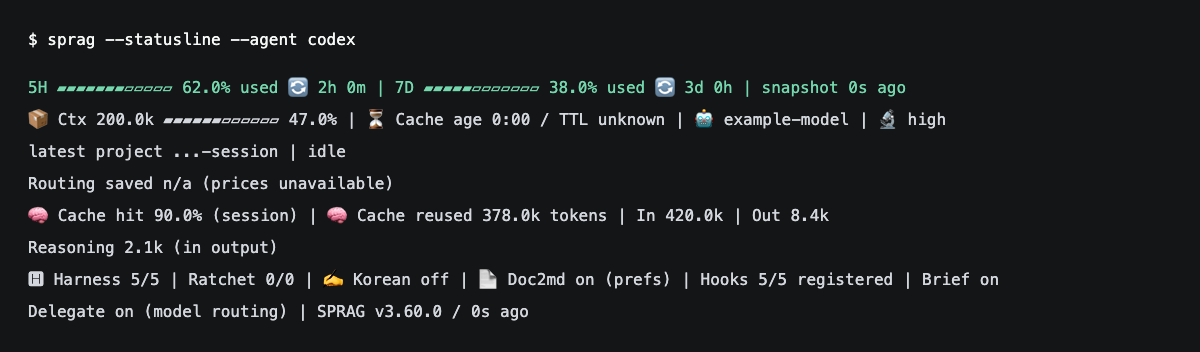
One command sets up Codex too when it is installed, with the rule presets registered globally. Then trust the Sprag hooks in Codex /hooks; Codex requires that step. Codex only: npm i -g sprag-cli --ignore-scripts then sprag install --agent codex.
The default install registers Claude Code hooks, its statusline and the rule presets. The only question comes when you already have a statusline: show both, replace yours, or keep yours. Add --manual to sprag install to confirm each step.
This one has no chip. The check runs as the text is written, and a violation stops the session on that file instead of waiting to be read off a status line.
COST
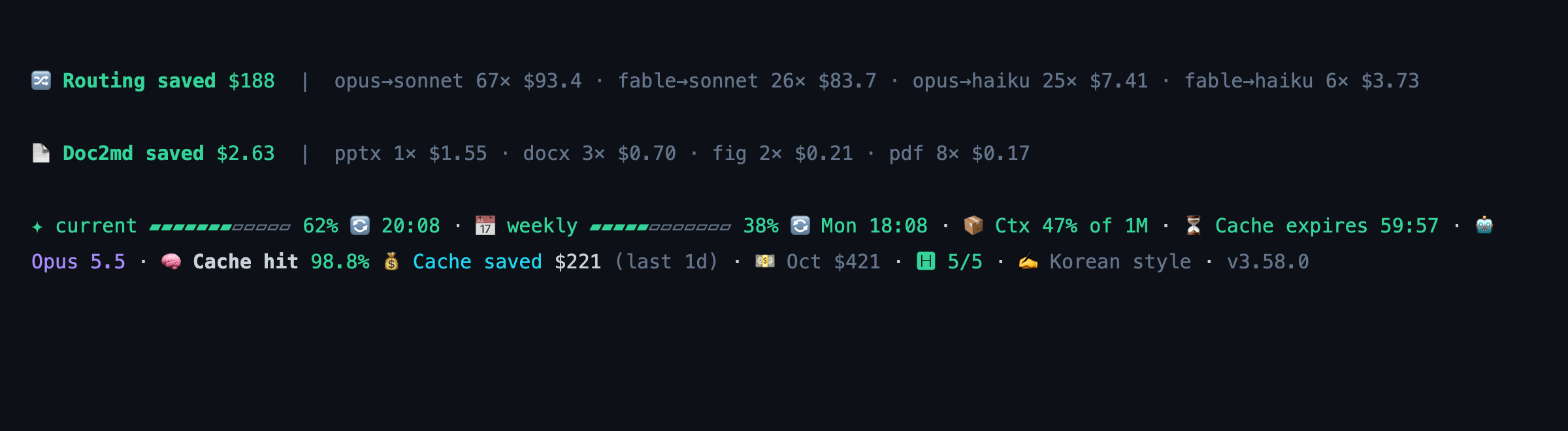
Cache hit rate, the expiry countdown, context use and both rate-limit windows are read every turn, and a warning chip moves to the front of the line when one of them needs you.
⚠ Ctx 500k+ · 🤖 Opus 5.5 · 🧠 Cache hit 98.8% · ⏳ Cache expires 59:46 · ✦ current ▰▰▰▰▰▰▰▱▱▱▱▱ 62% 🔄 21:33 · 📅 weekly ▰▰▰▰▰▱▱▱▱▱▱▱ 38% 🔄 Tue 19:33 · 📦 Ctx 47% of 1M · 💰 Cache saved $1.0K · last 1d
🚨 5H ▰▰▰▰▰▰▰▰▰▰▰▱ 94% 🔄 12:36 · 🤖 Opus 4.8 · 🧠 Cache hit 72.1% · ⚠ Cache miss · 📅 weekly ▰▱▱▱▱▱▱▱▱▱▱▱ 12% 🔄 Sun 14:26 · 📦 Ctx 200k · last 1d
Sprag installs once, reads the sessions you already run, and does not ask you to change how you prompt.
01
A repeat becomes a rule
The first failure is just work. On the second, Sprag surfaces it as a candidate. You approve the scope, and the rule loads at the start of every session after that.
2026-08-01 · appending to .env
→ check the trailing newline
  first (tail -c1)
02
Safe work goes to a sub-agent
When a task matches one your history shows is safe, Sprag spawns a sub-agent on a cheaper tier to do it and hands the result back for review. Anything that fails quietly stays with the main agent.
"git status"       → t2-runner
"build the app"    → t1-worker
"why is CI flaky?" → main agent
03
Cost trouble shows up early
Cache hit rate, TTL expiry, context growth and both rate-limit windows are read every turn and printed in your statusline, while you can still act on them.
⚠ Cache miss · input spike
🚨 7D 92% · run handoff
Stop paying flagship prices for work a cheaper tier already proved it can do
Sprag does not swap your model. It reads what you have already run, finds the kinds of task that never went wrong on a cheaper tier, and spawns a sub-agent for exactly those. The sub-agent returns its output to the main agent, which reviews it before anything counts as done. Every rule carries the error rate it was measured at, and the work comes straight back to the main agent the moment a rule stops holding.
Tier
Share (illustrative)
Goes there
Why it is safe
haiku
52%
lookups · status checks · test and lint runst2-runner sub-agent
Exit codes and diffs make a wrong answer obviousillustrative: 0% error over 41 delegated runs
Nothing catches a wrong call here except younever delegated, however routine it looks
How a tier gets picked: the criteria every rule shares
These ship inside the generated ratchet-model.md, above the rules, so the agent applies them to every delegation. The percentages are measured, not assumed.
01Where the answer lives
A lookup answered by the repo, a file, or command output is safe on haiku. A question answered from model knowledge is not. Measured recall: 28% on the cheap tier vs 54% one tier up.
02Whether a mistake surfaces
If the build, the tests, or an exit code will catch a wrong answer, the gate sets the quality floor and a cheap tier is safe. Work that fails silently (diagnosis, root-cause calls, security, design) never goes down a tier.
03Tool orchestration
A flow that feeds one tool's output into the next call never goes to haiku, whatever the call count. The accuracy gap on chained tool work measured +63pp, the largest of any task type.
04Batching
The dominant cost of a sub-agent is loading context, not generating. Tasks that read the same files ride in one agent; only tasks that read different ground get their own.
05Who writes, who decides
The main model fixes the design and writes a self-contained spec; a sonnet worker writes the bulk of the code. The main model reviews the diff and the test results before anything is reported done.
06Escalation
The same error twice, an answer splitting into candidates, or a sub-agent circling: each hands the work back. re-brief and retry, then one tier up, then the main model takes over.
Measured offline on LLMRouterBench (Findings of ACL 2026): 11,696 instances across 9 datasets. The tool-chain gap is from τ²-Bench, knowledge recall from SimpleQA-class sets. Method and holdout in docs/BENCHMARK.md.
The research behind the criteria
Each criterion traces back to published routing research. Criteria 04 and 05 have no paper behind them: they come from sprag's own cost accounting.
Routers fall short of the oracle mainly because they miss when a smaller model is enough, and difficulty is defined by how many of 42 models answered. Sprag judges difficulty by outcome too: tool errors and retries in your logs.
A cascade tries the cheap model first and a check on the answer decides whether to escalate, matching GPT-4 at up to 98% lower cost. This is criterion 06.
Cache hit rate, TTL, context size, output spikes and both rate-limit windows, in the prompt every turn.
q3-review.pptx 30MB540,429 tok → 22,610 tok✓ −95.8% before the model reads it
doc2md
pptx, xlsx, pdf, docx and fig converted on demand, so a document costs a read instead of a context bomb.
✗ 보여집니다 (이중 피동)✓ 보입니다blocked at write time, by hook
Style gates
Write-time prose lint enforced by hook. Shipping today for Korean technical writing: double passives, translationese, cohesion.
Questions people ask first
Is this the same tool as claude-token-saver?
Yes. The current npm package is sprag-cli. The old claude-token-saver package is deprecated; existing configuration is preserved when you migrate.
Does it call an LLM or need an API key?
Local Claude Code and Codex log analysis needs no API key or extra model calls. Optional Codex budget and price lookups contact your configured LiteLLM endpoint with its existing credentials. Session content is not uploaded.
Will it change how I prompt?
No. It installs hooks and a statusline once, then works from what you already do. Rules, delegation, and warnings show up inside your normal sessions.
Where do the savings numbers come from?
The historical figures above come from Claude Code. Codex keeps a separate ledger for Sprag-routed child runs with matching provider prices. Both compare the same observed tokens at two rates: an estimate, not a billing measurement. Missing prices remain unknown.
Does Codex use the same statusline?
Codex gets a companion terminal panel or an inline tmux layout. Its native footer does not execute shell commands. See the Codex guide for setup, hook trust, and platform differences.
 Tap to enlarge
 Tap to enlarge